
Emergency Air Duct Cleaning Near Me: What Placentia Homeowners Should Do First
If your vents are blowing debris after a rodent infestation or fire damage, running the HVAC while you search for a cleaner is actively spreading the contamination. Step one is the system switch, not the phone call. Turn the thermostat to off, close the registers in the affected rooms, and only then start figuring out who to call. That order of operations matters far more than which company you pick in Placentia. If you’d rather hand it off, call (866) 937-8913 and we’ll walk you through the next step.
A “duct emergency” isn’t one problem. It’s four different problems that happen to look similar from the living room. In our experience, the homeowner who panics and calls the first number on the search results often makes the eventual cleaning job harder, not easier. Below is the triage sequence we’d want a Placentia neighbor to follow before anyone shows up.
Key Takeaways
- Shut the HVAC off before anything else. A running system pushes loose contaminants deeper into the home.
- Match your first response to the actual scenario: rodent, soot, water or construction dust.
- Photograph the vent covers, filter, and visible debris before touching a thing.
- Treat “same-day” with a skeptical eye when it comes with a vague scope.
- Expect a follow-up step. One cleaning visit rarely ends a real contamination event.
What Are the Four Real Duct “Emergencies” and How Should You Respond to Each?
The four scenarios that justify treating a duct problem as urgent are rodent intrusion, post-fire soot, water intrusion with mold potential, and construction dust that got pulled into the system. Each has a different correct first move, and using the wrong one can move contaminants further into your living space in Placentia.
1. Rodent intrusion. Droppings, shredded insulation, and a smell that gets worse when the heat kicks on. First move: shut the system off entirely. Don’t just drop the fan to “auto” and hope. Rodent waste carries pathogens, and a running blower aerosolizes dried material. Keep pets and kids out of the affected rooms while you handle it.
2. Post-fire soot. Even a small kitchen fire can pull soot through return ducts. Soot is oily and clings to duct walls, and every hour the system runs, more of it redistributes into rooms that were never touched by the fire. First move: system off, and don’t run any fans or central air as a “ventilation” fix.
3. Water intrusion or mold potential. A slow leak behind a wall, an AC condensate mishap, or a ceiling stain near a register. First move: system off, get the moisture source stopped, and photograph everything. A wet duct cleaned before it’s dry is a wasted cleaning.
4. Construction dust breach. Remodeling work that wasn’t isolated from the HVAC, or a filter bypass that let drywall dust through. First move: stop running the system for heating or cooling, change the filter, and document the filter’s condition before you do.
Why Does Shutting Off the HVAC Matter More Than Calling Anyone?
Because a running air handler is a positive-pressure pump for whatever is sitting in your ducts. Residential duct systems are designed to move air, and they don’t distinguish between conditioned air and loose contaminants. Whatever dust, soot, or rodent debris is sitting inside the ducts gets pulled into the supply airflow and pushed out through every register in the house.
Here’s the part that surprises homeowners in Placentia: the return side is just as bad. Return grilles pull air from living spaces back to the air handler, and any debris sitting near a return gets recirculated through the system. Running the fan “to clear the air” does the opposite. It’s the same reason a contractor who’s cutting drywall in a home should seal off the HVAC before the first cut.
So the sequence looks like this:
- Set the thermostat to off. Not “fan on.” Off.
- Close the supply and return registers in affected rooms.
- If there’s a smell, don’t burn candles or spray air freshener. It masks the smell and adds residue to the ducts.
- Leave the system off until a technician has inspected it.
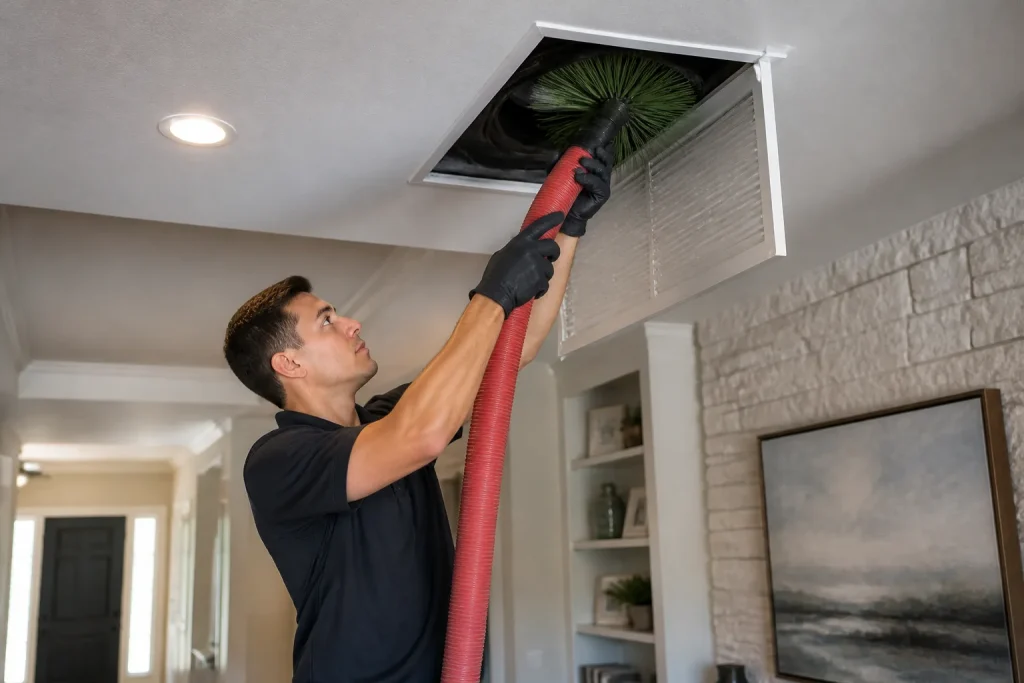
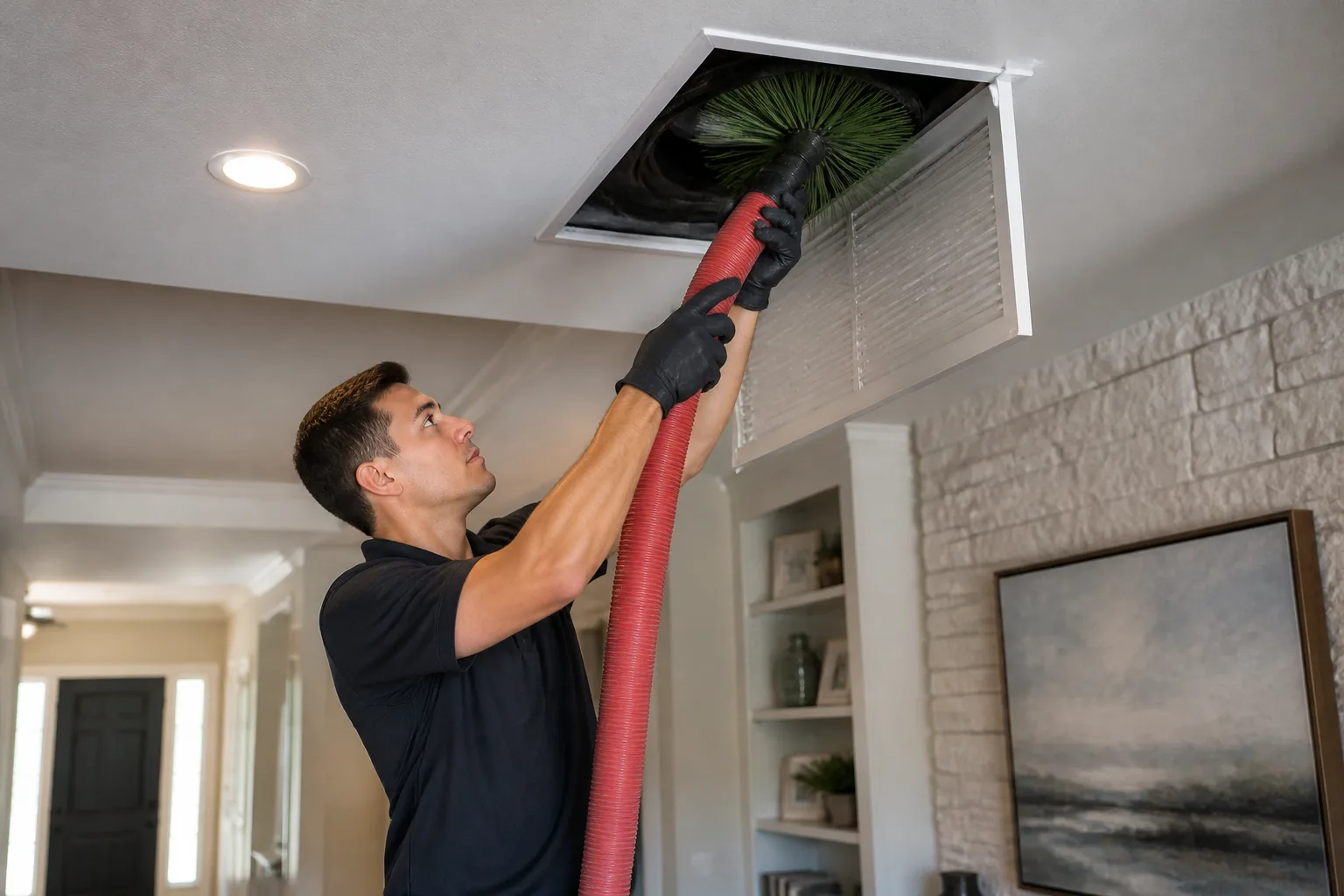
We’ve watched what a professional-grade setup does differently. Rotobrush and Nikro equipment is the standard for certified HVAC cleaning work, and pairing that with Abatement Technologies negative-air filtration means dislodged debris gets captured at the source instead of recirculating through the home while the cleaning is happening.
What Should You Photograph Before Anyone Touches the System?
Document the vent covers, the filter, the visible debris in and around each register, and the thermostat setting. That photo set is worth having whether you end up filing an insurance claim or simply verifying the work later, and it takes about two minutes in Placentia.
What to capture, in order:
- Each register, closed up. A close shot of dust, debris, or staining around the grille.
- The filter itself. Before you swap it. Pull it out where the light hits it and photograph both sides.
- Anything visible in the duct. If you can see debris with a flashlight through a register, that photo belongs in the set.
- The air handler area. Any rust, moisture, or staining near the unit.
- Wide shots of affected rooms. The register shots help nothing without context.
For insurance purposes, the photos matter more than you’d think. Adjusters want to see condition before work started. And for verifying the cleaning itself, a proper before-and-after set of your own vents is the simplest check there is. If a company can’t show you their own before-and-after photos on request, that’s a sign.
What Does “Same-Day” Signal About a Duct Cleaning Company?
It signals nothing by itself. Same-day availability is legitimate when the scope, equipment, and price are clear up front, and it’s a red flag when the fast arrival comes with vague scope and a price that grows once the technician is inside. Placentia has no shortage of duct cleaning outfits, and the way to tell them apart is what happens before the visit, not how quickly it comes.
Questions worth asking on the phone:
- What equipment goes on the truck? Rotobrush and Nikro are the real names. If the answer is vague, that tells you something.
- Is the price per system or per vent? Per-vent pricing is where bait-and-switch lives. A whole-system price agreed before work starts is the version you want.
- Is the work captured at the source? Meaning: does the company deploy negative-air filtration, or just vacuum and release?
- Is repair part of the visit? If a duct is crushed or has a leak, can they seal it while they’re there, or is that a second contractor?
- Can they show you photos afterward? Before and after, of your own ducts.
Our answer to all five: a service that cleans it, repairs it, and seals it in one visit, with equipment from companies HVAC professionals already use. There’s no gimmick in being clear about scope. The comparison to make isn’t “who can arrive fastest.” It’s “whose visit actually ends the problem.”
When Should You Call a Pro Instead of Waiting?
Call a professional when the debris is beyond what a vacuum and a filter change can address, when the contamination source is inside the duct system, or when there’s any reason to suspect mold or rodent waste has reached the supply side of the system. That’s the point where a shop vac stops being useful and starts being a way to make it worse.
The specific situations where we tell Placentia homeowners to stop and call:
- Visible debris blowing out of registers while the system is on
- A burning or musty smell that comes back after the system has been off for a day
- Evidence of rodents in the ducts, in the air handler, or in the insulation
- Water staining or visible moisture near a register or the air handler
- Anyone in the home with asthma or severe allergies reacting after a contamination event
If any of those are true, the DIY window has closed. Call (866) 937-8913. We answer 24/7, with fast dispatch from 7am to 7pm, Sunday through Friday. Our technicians have up to 12 years of experience and the inspection is on us.
Why Isn’t One Cleaning Visit the End of the Problem?
Because a single visit cleans the system, not the confirmation that the air is actually better. Post-emergency cleaning is a two-part job: the contamination removal, then a check that the air quality reflects the cleaning. Skipping the second part in Placentia means hoping the job worked instead of knowing it did.
In our experience, a proper follow-up includes:
- Air quality verification. A reading taken after the cleaning that you can look at, not a verbal “looks good.”
- Filter review. Post-cleaning filters sometimes load faster than usual, and that’s a sign worth catching early.
- Sealing check. If leaks or damage were found during the cleaning, this is where they get sealed, and where a follow-up visit makes sure the seal is holding.
- Sanitizing where appropriate. For rodent or mold scenarios, integrated products from Honeywell and Aprilaire are what we draw from, not generic sprays.
That last piece is what “your air quality, documented” means in practice. The cleaning is the easy part to sell. The verification is what you’re actually paying for.
The Bottom Line
Turn the system off first, photograph everything, match your response to the actual scenario, and treat “same-day” as a question to ask, not a reason to book. If you’re in Placentia and need help, Placentia Air Duct Cleaning Pros offers free estimates. Call (866) 937-8913. We answer 24/7, with fast dispatch from 7am to 7pm, Sunday through Friday. The estimate is free and the price is set per job by the written estimate.
Related services in Placentia: air duct cleaning, HVAC cleaning, and dryer vent cleaning if the smell source turns out to be dryer-side rather than duct-side. Our full menu, from cleaning through repair, sealing, and sanitizing, is described here: Placentia Air Duct Cleaning Pros.
Frequently Asked Questions
No, not if the system is contaminated. A running system pushes loose debris through every register in the home. Turn the thermostat off and keep it off until a technician inspects. Call (866) 937-8913 for an exact quote – estimates are free.
We don’t quote prices over the phone and you shouldn’t trust a company that does. The final price is set per job by the written estimate, after inspection. Call (866) 937-8913 for an exact quote – estimates are free.
Ask for before-and-after photos of your own ducts, not a stock image. We provide them. You should also get a written scope description and, where applicable, an air quality reading after the cleaning. Call (866) 937-8913 for an exact quote – estimates are free.
Usually because the equipment is consumer-grade, the scope is vague, or the price grows once the technician is on site. A cheap up-front number is sometimes a low-scope cleaning priced to get in the door. Rotobrush and Nikro equipment with Abatement Technologies filtration and a written estimate in hand is what separates a real quote from a teaser. Call (866) 937-8913 for an exact quote – estimates are free.
You can clean after a fire. Photograph everything first, then get the cleaning scheduled. We work with your insurer on documentation, and the estimate is the estimate. Call (866) 937-8913 for an exact quote – estimates are free.
Written by the team at Placentia Air Duct Cleaning Pros.
Need Air Duct Cleaning Help?
Call Placentia Air Duct Cleaning Pros - the local pro we connect you with is licensed and insured, with free written estimates in Placentia.
(866) 937-8913