
Nikro Air Duct Cleaning in Placentia: A Homeowner’s Guide
Most duct cleaning companies mention their equipment once, in passing, and hope you don’t ask follow-up questions. Here’s the one that matters: Nikro’s portable containment units move air at rates that top 2,000 CFM, and that number is the whole ballgame. It’s the difference between debris being captured at the source and debris being loosened, blown around, and quietly redistributed through your Placentia home. If you’ve ever had ducts “cleaned” and noticed more dust the next week, you probably know which side of that line the job landed on.
This guide explains what Nikro negative air equipment actually does inside your ducts, how to confirm a technician is running it correctly, and where equipment alone stops short. If you’d rather have a pro handle it than trace pressure gauges yourself, call (866) 937-8913.
What does Nikro equipment actually do inside your ducts?
Nikro negative air machines create a sealed vacuum on your duct system, so the entire duct network sits under lower pressure than the rooms around it. Contaminants loosen from the duct walls and move toward the machine, not into your living space. That’s the mechanical job. The cleaning tools do the agitation; the negative air machine makes sure what gets dislodged leaves the system.
Why does the pressure direction matter so much? Because ducts are porous, jointed, and never perfectly sealed. In a push-pull setup, one hose blows air through the system while another pulls from the far end, and anything that escapes a leaky joint ends up in the wall cavity or back in the room. A containment approach running a negative pressure differential across the whole system reverses that flow. Debris travels one way: out.
We pair Nikro’s vacuum side with Rotobrush agitation tools, which is how professional duct cleaning crews work everywhere. One tool loosens what’s stuck to the duct wall, and the other guarantees it doesn’t stay in your house. Neither works well alone.
How do you visually confirm Nikro equipment is being used correctly?
You don’t need to be an HVAC technician to check this. Spend two minutes watching before the work starts, and you’ll know more than most homeowners ever do.
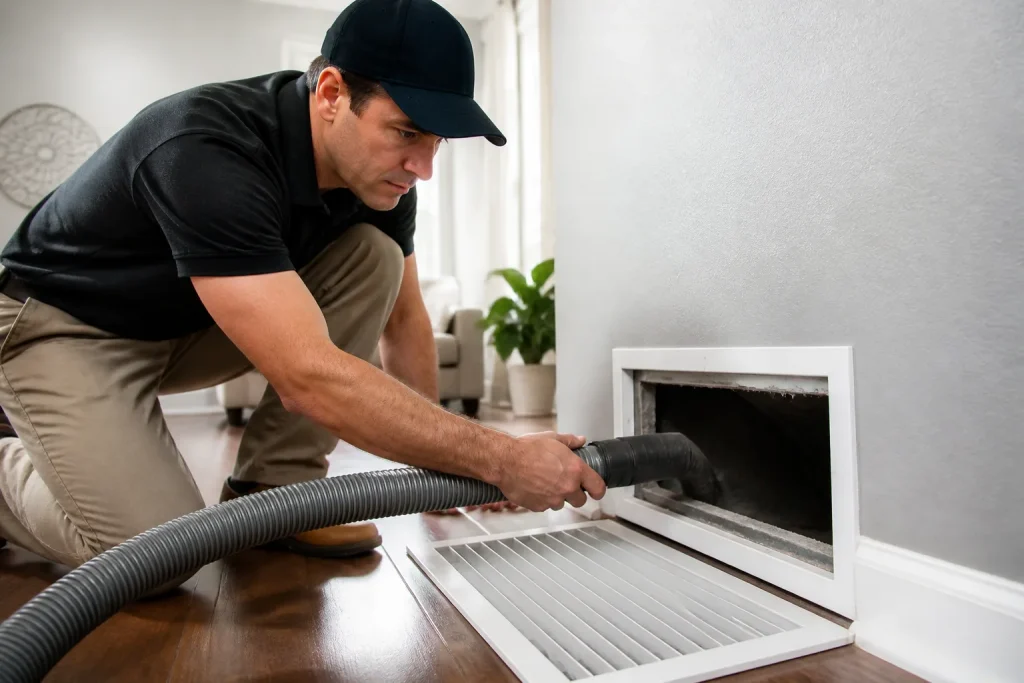
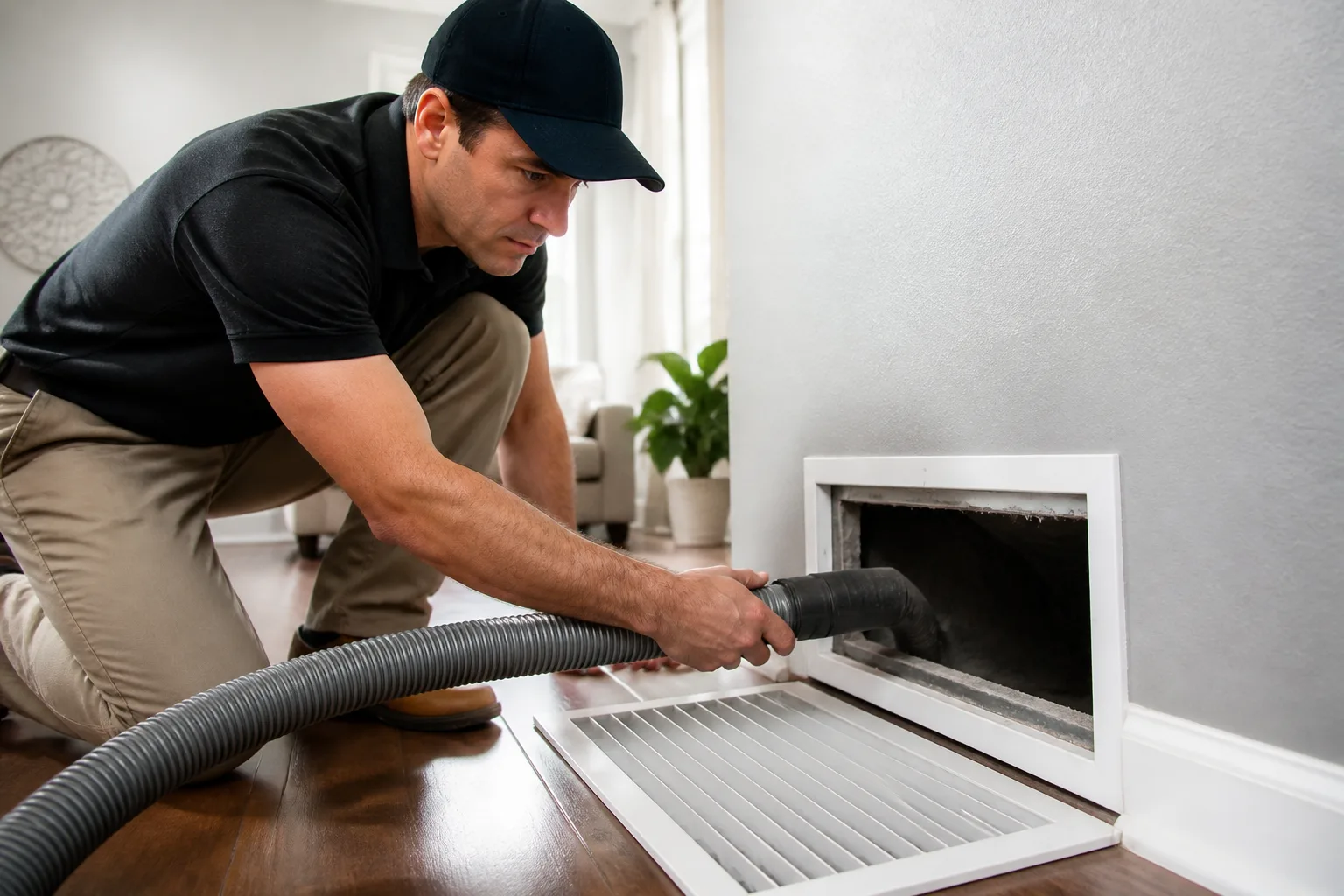
- Hose diameter. The main vacuum hose should be thick and heavy and connect to a large portable unit, not a shop vac on a dolly. If it’s the same hose you’d use in a garage, walk away.
- Attachment point. The containment hose connects to a main trunk line or a purpose-built access port, sealing your system as a whole. A technician working vent by vent with a small wand isn’t running containment.
- Pressure gauges. Nikro units have visible gauges. A technician should be able to tell you what reading they’re holding and why.
- Access preparation. Proper access means cutting small service openings or tapping existing ones and sealing them with tape before the vacuum starts. No prep means no real containment.
- A second unit on the room side. Abatement Technologies filtration equipment should be running in the work area to catch particles disturbed during access. That’s the belt-and-suspenders setup a serious crew brings.
If your technician can’t walk you through the setup, that’s your answer. Call (866) 937-8913 and we’ll walk you through what a proper Nikro setup looks like before you book anything.
Why does this matter more in Placentia’s older tract homes?
Placentia has a lot of homes built between the 1970s and the 1990s, and a large share of those have flex duct or interior-lined metal duct running through attics and crawlspaces. Flex duct is corrugated and ribbed inside, which catches dust in ways smooth metal never does. Older fiberglass liner is the more serious issue: as it ages, it sheds fibers and traps debris against the duct wall, and once that liner begins to degrade, the contamination isn’t sitting on top of a surface you can wipe. It’s embedded.
That’s exactly where the negative pressure approach earns its keep. A gentle push-pull flow won’t pull embedded material out of a degrading liner, and it risks spreading fiberglass particles through the system. A containment setup under controlled vacuum lifts and traps what the agitation tool has loosened, then holds it in a sealed filter rather than letting it drift through the attic.
Homes from this era often have attic duct runs that haven’t been touched in decades. When we inspect, we’re looking for liner condition and joint integrity at the same time as dust buildup. Those three things are connected, and ignoring one makes the other two pointless.
Why doesn’t Nikro equipment alone fix collapsed or disconnected ducts?
This is the part most homeowners miss: cleaning and repair are different jobs. Nikro equipment does an excellent job of removing debris. It cannot reconnect a disconnected flex run, reinforce a collapsed section, or seal a joint that has been leaking your conditioned air into the attic for years.
Here’s what typically happens. You book a cleaning, the crew runs the Nikro equipment, the ducts look better on camera, and a month later the airflow problem is back. Why? Because there’s a run that’s collapsed or disconnected, and no vacuum can fix that. The dust didn’t come back out of nowhere; it came back because the system is still leaking and pulling in attic air.
This is where a single-scope duct cleaner runs out of road. A proper job surfaces the problem and solves it in the same visit. Duct repair and sealing capability means that when we find a disconnected run or a joint leaking air, we can fix it on the spot rather than handing you a report and a second contractor’s phone number. That’s why we handle HVAC cleaning and duct repair and sealing as part of the same visit. Clean, repair, seal. In our experience, the cleanest duct system in the world still won’t hold if the ductwork itself is broken.
What should a completion report include after a Nikro-method job?
You paid for a service, and you should have something to show for it beyond a verbal “looks good.” Here’s what a proper completion report should include:
- Before-and-after camera footage. Wide-angle photos of your actual ducts, not stock images. Duct interior shots before and after, in the same locations.
- CFM readings at key registers. Numbers before and after, so you can see whether airflow improved.
- Filter condition notes. Whether the unit filters were clean, loaded, or approaching end of life, and whether any need replacing.
- Repairs performed. If you have access ports cut, joints sealed, or runs reconnected, that should be listed.
- HVAC cleaning notes. Evaporator coil and blower condition, and whether either needed attention.
We include these because they’re verifiable. A homeowner in Placentia who sees factory photos of their own ducts and reads CFM readings before and after knows the work actually happened. If a company can’t produce this, ask why. The best documentation is the documentation of your house.
Related services in Placentia
Nikro equipment is just the entry ticket. Full-scope air quality work in Placentia covers a few distinct jobs that work best together. air duct cleaning removes accumulated dust and debris from the system. If you notice lint or a hot laundry room, dryer vent cleaning addresses a fire risk most duct cleaners don’t touch. And when ducts are damaged rather than just dirty, duct repair and sealing restores the system so the cleaning holds. All of it runs through Placentia Air Duct Cleaning Pros, so you’re not handing off between contractors. Honeywell and Aprilaire products are integrated into our air quality and sanitizing work where filtration or sanitization adds real value.
What happens when you call
- 1
A real person answersNo phone trees – you reach a local pro.
- 2
You get an upfront price rangeHonest numbers before anyone is dispatched.
- 3
A background-checked tech heads outLicensed & insured, dispatched right away.
- 4
You approve before work beginsNothing starts until you say go.
When to call a pro
If you’re seeing dust on every surface after you dust, noticing musty odors when the AC kicks on, or feeling uneven airflow between rooms, those are the signals. Duct cleaning is a scheduled job, not an emergency, so it doesn’t need to happen in the middle of the night. That said, if a duct panel has come loose or you smell burning, shut the system down and call. We answer 24/7. Fast dispatch from 7am to 7pm, Sunday through Friday.
The Bottom Line
Nikro negative air machines don’t just look professional – they’re a specific mechanical standard that either was or wasn’t met on your job. The vacuum needs to hold the system under negative pressure, the debris needs to be captured in sealed filtration rather than released into your attic, and the whole thing needs to be backed by a report showing your ducts before and after. In Placentia’s older tract homes, that containment approach matters more than anywhere else because aging duct liner will shed if you disturb it without proper filtration. And remember: cleaning is only half the job. If the ducts are collapsed, disconnected, or leaking, they need repair and sealing too.
If you’re in Placentia and need help, Placentia Air Duct Cleaning Pros offers free estimates – call (866) 937-8913. We’ll explain the equipment we’re using, show you what proper containment looks like, and give you a documented result you can actually inspect.
Frequently Asked Questions
Most Placentia homeowners pay for a whole-system cleaning, not per vent, and pricing depends on the size of the system and whether repairs or sealing are needed. We give one flat price per system after an inspection, written into the estimate before work begins. Call (866) 937-8913 for an exact quote – estimates are free.
Because the cheap quote is often for a push-pull job with consumer-grade equipment and no containment, or a per-vent price that balloons once the technician is on site. If the quote doesn’t name the equipment and doesn’t include before-and-after footage, the price is the only thing you can verify. Call (866) 937-8913 for a quote that includes what’s actually being done.
You ask for the completion report: camera footage of your own ducts before and after, CFM readings at the registers, and notes on filter condition. Those are things a company running proper Nikro and Abatement equipment can produce. If a company can’t show you, look elsewhere. Call (866) 937-8913 and we’ll walk you through what a report should contain.
It depends on the condition of the system, not a calendar. Homes with pets, recent remodeling, or aging flex duct need it sooner than a clean, well-sealed system. If you’re noticing dust buildup or odors, get an inspection first. Call (866) 937-8913 – our technicians have up to 12 years of experience reading exactly those signals.
Written by the team at Placentia Air Duct Cleaning Pros.
Need Air Duct Cleaning Help?
Call Placentia Air Duct Cleaning Pros - the local pro we connect you with is licensed and insured, with free written estimates in Placentia.
(866) 937-8913